

When a group exits an overseas market, the dissolution filing itself is rarely what goes wrong. What goes wrong is everything that was still open when the filing was made: final payroll, unsettled tax, an outdated bank mandate, an intercompany balance that never agreed.
In this guide, we set out how to close a foreign subsidiary in the right order. It covers the kickoff checklist, parallel workstreams, gated steps and the different final-filing routes in Singapore, the UK and Delaware.
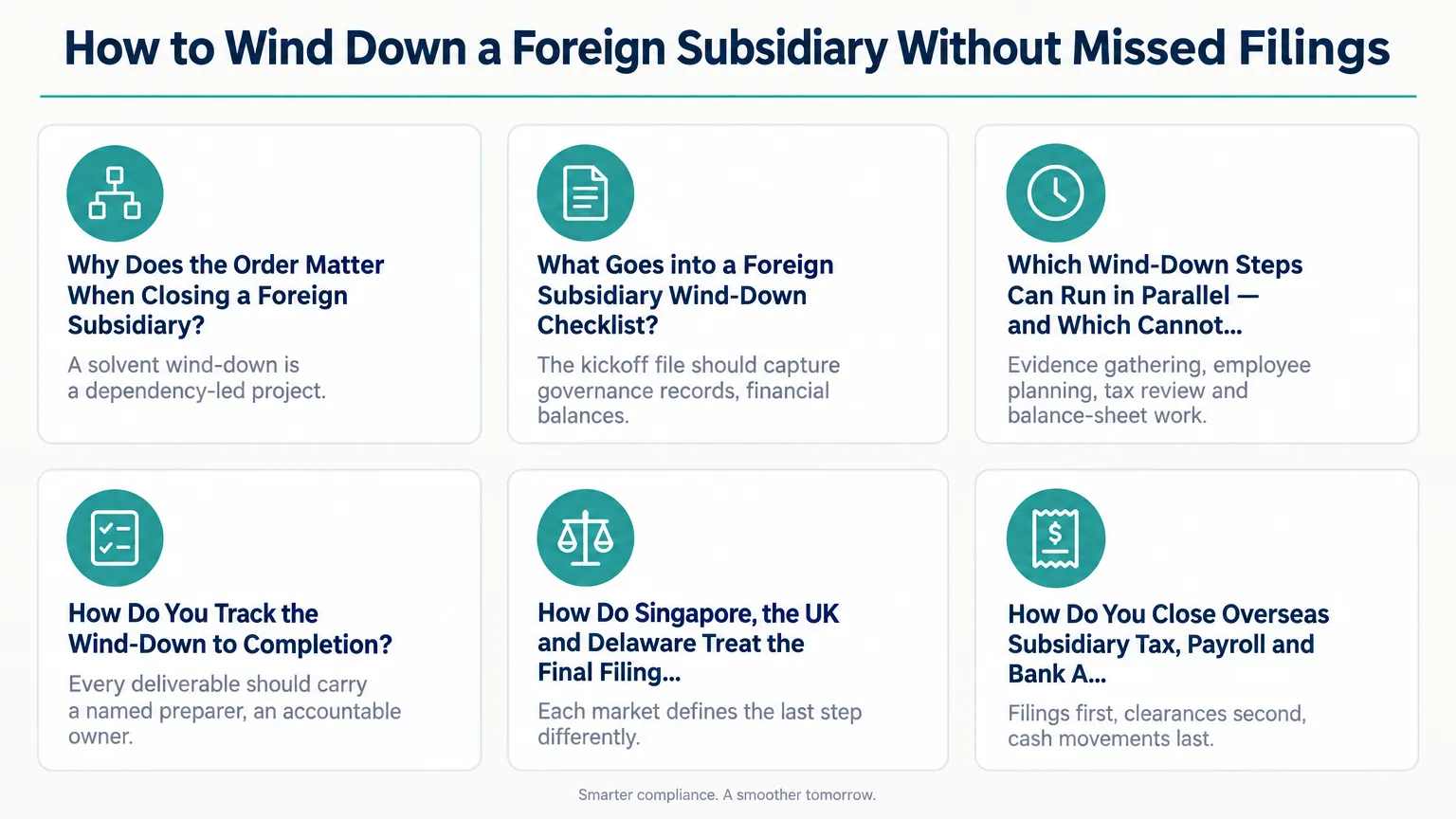
Why Does the Order Matter When Closing a Foreign Subsidiary?
A solvent wind-down is a dependency-led project: the dissolution filing is the final step, not the first one.
Closing the incorporation jurisdiction alone is never enough, because registrations can sit in several markets at once. We advise clients to search every jurisdiction where the entity had employees, premises, inventory or sales activity. A dormant payroll or indirect-tax registration left behind keeps generating filing obligations long after deregistration.
In practice, wind-downs fail quietly. An entity is struck off while a tax refund is still owed, or a signatory resigns before the final bank transfer is approved. The foreign company dissolution process should therefore be planned as a country-neutral framework, not a universal legal order. The entity type, the applicable route and local law determine the actual sequence.
That said, the framework holds across markets: gather evidence first, exit people and contracts, settle tax and balances, then gate the cash, the bank and the filing. This is a planning view from our work with groups, and it must be confirmed against local law for each entity before it is relied on.
What Goes into a Foreign Subsidiary Wind-Down Checklist?
The kickoff file should capture governance records, financial balances, tax history, employment data and commercial commitments before any closure step begins.
We open every wind-down engagement by building a single evidence file. The suggested checklist below reflects what we ask for when a member firm picks up an international subsidiary closure. Where an item cannot be produced, that gap becomes the first workstream of the project.
The documents matter more than assurances. Tax returns may sit in a former adviser's portal, and payroll data may sit with a provider whose engagement has already ended. We require source documents and portal downloads, not a verbal confirmation that an account is clear.
Common weak points we test at kickoff include:
- the intercompany ledger, where each side records different amounts, currencies or counterparties
- bank mandates and signatory lists that were never refreshed
- contract renewals that rolled over unnoticed
- evidence that old payroll or indirect-tax accounts were actually closed
- statutory registers not updated after a director or share transfer
This is a non-ranked list of items to test, not a ranking. Each one is a missed filing waiting to surface after deregistration.
1. Governance and statutory records
Constitutional documents, certificates and amendments, shareholder and director registers, beneficial-owner records, minute books and licences belong in the file. Every jurisdiction where the entity is registered for tax, employment or business purposes is listed at the same time.
2. Financial balances and the intercompany ledger
The last three years of filed financial statements, trial balances and general ledgers are collected, alongside current management accounts and the fixed-asset register. The intercompany ledger is built counterparty by counterparty, with confirmations from both sides.
3. Tax, payroll and registration history
Filed corporate, Goods and Services Tax (GST) or Value Added Tax (VAT), withholding and payroll returns are gathered with assessments, correspondence and payment evidence. Transfer-pricing files and any open audit correspondence complete the picture.
4. Contracts and commercial commitments
A contract register shows notice periods, auto-renewals, deposits, data-return duties and termination charges. Guarantees, security interests and loan documents are pulled alongside it.
Wind-Down Workstreams and Their Dependencies
| Workstream | Runs concurrently? | Gated by |
|---|---|---|
| Employee exit planning | Yes, alongside tax review and reconciliation | Final payroll and social filings fix termination dates |
| Tax review and final filings | Yes, but filings need reconciled balances | Clearance or no-objection depends on settled liabilities |
| Intercompany reconciliation | Yes, started early | Distribution characterisation depends on agreed balances |
| Final distributions | No | Tax review, creditor provision and sign-offs |
| Bank account closure | No | Refunds, final fees and distributions cleared |
| Dissolution or deregistration filing | No | Statutory eligibility for the route |
Which Wind-Down Steps Can Run in Parallel — and Which Cannot?
Evidence gathering, employee planning, tax review and balance-sheet reconciliation may run together; final distributions, bank closure and the dissolution filing should never be treated as independent tasks.
Concurrent workstreams compress a timetable, but only where local requirements and the facts permit; they cannot be assumed to run together in every case. In a well-run file, a phase moves when a document arrives, not when a status update says a task is complete. Signed employee terminations, a nil-liability balance sheet, a tax clearance or no-objection letter, and a bank closure confirmation are the evidence that unlocks the next phase.
The final steps are gated because they depend on everything before them. The most damaging sequencing errors we guard against include:
- closing the bank before a tax refund or final fees have cleared
- resigning the only authorised director or signatory before the last transfers are approved
- distributing cash before creditors are paid or reasonable provision is made for claims
- writing off intercompany debt without analysing withholding tax, transfer pricing, exchange movements and debt-release consequences
The last point is a general warning, not a rule of any one jurisdiction. Intercompany write-offs change the character of the residual cash, and that character drives the parent's tax outcome. Local and parent-jurisdiction tax review should precede any write-off decision.
How Do You Track the Wind-Down to Completion?
Every deliverable should carry a named preparer, an accountable owner, a required signatory, a dependency, a deadline and the document that proves completion.
We recommend running a wind-down on a task-level responsibility matrix rather than a milestone list. That is a control design we recommend; it is not a claim about any established engagement template. The matrix forces each filing, payment and closure to name the person who prepares it, the person accountable for it, and the signatory who must approve it.
Completion is evidenced by documents. A nil-liability balance sheet, a signed termination file, a closure letter from the bank or a no-objection notice from a tax authority closes a task. A status update does not. Where an external party — a registry, a tax office or a bank — controls the timing, the dependency and its expected evidence are recorded on the same line.
This is how we help clients keep international subsidiary closure steps visible across borders. One owner in the parent, one in the subsidiary market and a single evidence file remove the gaps in which missed filings hide.
How Do Singapore, the UK and Delaware Treat the Final Filing?
Each market defines the last step differently, and the differences are exactly where missed filings hide.
These three markets illustrate how differently closure is defined. The examples below reflect authority guidance. The route that applies depends on the entity type, its facts and the law in force on the filing date. Confirm the route, forms and eligibility with local advisers before relying on any example.
Singapore distinguishes between striking off and winding up. Strike-off under the Accounting and Corporate Regulatory Authority (ACRA) is available to an inactive company that:
- has no outstanding debts or unresolved government issues
- has no pending legal or regulatory proceedings
- has no remaining assets or liabilities
Winding up is the route where debts must be settled. Closing the company does not end its tax obligations. Under the Inland Revenue Authority of Singapore (IRAS), a company generally must file its Estimated Chargeable Income (ECI) within three months of its financial year-end. A waiver may apply. For Year of Assessment (YA) 2026, the annual return is due by 30 November 2026. The relevant return is Form C-S, Form C-S (Lite), Form C or, for an eligible dormant company, Form for Dormant Company. The ECI waiver applies only where annual revenue is S$5 million or below and the ECI is nil.
The United Kingdom (UK) route for a clean, solvent entity is voluntary strike-off through Companies House. Companies House guidance lists conditions for this route. A company must not have traded in the previous three months, except for activities necessary to:
- conclude the company's affairs
- comply with the law
- make the application
A copy of the application must be sent to prescribed interested parties within seven days. Assets, including bank accounts, should be dealt with before dissolution. Remaining assets can pass to the Crown, and access to the account is lost. Employer schemes and VAT registration must be closed where applicable. An interested party can object to strike-off with evidence of unresolved liabilities.
In Delaware, the dissolution route depends on the corporation's factual status. The Division of Corporations provides different forms for different statutory sections. Not every closure is a voluntary dissolution; the share, business and approval facts determine the route. Where Form 966 applies, it is a federal filing. A corporation must file it with the Internal Revenue Service (IRS) within 30 days after adopting a dissolution resolution or plan. It is not a Delaware state filing or a tax clearance. Delaware law continues the corporation for three years after dissolution for specified winding-up and litigation purposes. A court may extend this period. The filing date is therefore not the end of the compliance story.
Closing a Subsidiary: Singapore, UK and Delaware Compared
| Aspect | Singapore | UK | Delaware, US |
|---|---|---|---|
| Common solvent route | Strike-off of an inactive, debt-free company; winding up where debts remain | Voluntary strike-off via Companies House | Statutory dissolution route depends on the corporation's status |
| Condition before filing | No debts, no pending proceedings, no assets or liabilities | No trading in the previous three months, subject to exceptions | Required approval depends on the statutory route; for example, section 275 permits board-and-stockholder approval or unanimous written consent of all voting stockholders without director action. |
| Tax step | Final ECI and Form C-S/C still due; Form C-S/C by 30 November 2026 (YA 2026) | No general clearance certificate; unresolved tax can prompt objection | IRS Form 966 within 30 days after the dissolution resolution or plan |
| Life after filing | Gazette process before dissolution completes | Gazette notice and objection period | Corporation continues for winding-up purposes, generally three years |
How Do You Close Overseas Subsidiary Tax, Payroll and Bank Accounts?
Filings first, clearances second, cash movements last: that is the order that keeps the final filing clean.
When you close an overseas subsidiary, tax, payroll and bank account closures are the tracks that must finish in the right order. Each track is closed only against evidence, and none of them is closed on a verbal assurance. The four tracks below are where the sequencing traps live.
1. Final tax filings and clearances
Every registration the entity holds — corporate income tax, GST or VAT, withholding and payroll — produces one last filing. In some routes, a tax authority's consent or no-objection is a precondition to deregistration; in others it is not, but unresolved liabilities can still block closure. We map each filing, its statutory deadline and its evidence before any dissolution step.
2. Employees and final payroll
Terminations, accrued leave and bonuses, final payroll runs and social-security or pension closures follow the employment law of each market. In the US, employers closing a business must file applicable final federal employment-tax returns. Employment-tax records are kept for at least four years, while state payroll and unemployment rules can differ.
3. Bank closure and residual cash
We keep the bank account open until refunds, final fees and distributions have cleared, then obtain written confirmation of a zero balance and closure. Residual cash is classified and approved before transfer, because its treatment differs as a loan repayment, dividend, return of capital or liquidation distribution. That classification requires local and parent-jurisdiction tax review, and foreign-exchange controls in markets such as China call for current local advice.
4. Post-closure contact
The parent should retain a named contact and a tested address for late notices, refunds and litigation. This is an operational recommendation; it does not replace any statutory registered-office, agent or records-custodian requirement.
Residual Cash Classification Before Transfer
| Payment type | What it may represent | Confirm before transfer |
|---|---|---|
| Loan repayment | Repayment of intercompany borrowing | Ledger balances agree on both sides, and withholding tax is analysed |
| Dividend | Distribution of accumulated profits | Distributable reserves, solvency and parent-jurisdiction tax treatment |
| Return of capital | Repayment of share capital | Statutory capital-reduction procedure and creditor protection |
| Liquidation distribution | Final distribution on winding up | Creditor claims paid or provided for, and local filing sequence complete |
What Must Survive After the Company Is Dissolved?
Records, a contact point and the tax files outlive the entity; deregistration does not end them.
Dissolution ends the company, not the record-keeping. Retention periods vary by market and record type. The table below sets out the general rules we work to in the markets discussed here. These are general rules only; employment, pension, property, litigation and regulatory records can carry longer duties.
In Hong Kong, business records are generally kept for at least seven years. Former directors of a dissolved company must retain its books and papers for at least six years after dissolution. In the UK, company and accounting records are generally kept for six years from the end of the relevant financial year. Longer retention applies in specified circumstances. In the US, the four-year federal employment-tax record rule sits alongside state-level obligations that may differ.
Where a former adviser holds files, we obtain copies before engagements end. Audits, refund claims and disputes can arrive after the entity is gone, and the parent is the party that has to answer them.
Record Retention After Dissolution
| Jurisdiction | General retention rule | Caveat |
|---|---|---|
| Hong Kong | Business records generally at least seven years | Former directors keep books and papers at least six years after dissolution; depends on record type |
| UK | Company and accounting records generally six years from the end of the financial year | Longer retention applies in specified circumstances; other record types may differ |
| US (federal) | Employment-tax records at least four years | State payroll and unemployment obligations may differ |
| Singapore | Confirm with Singapore tax and corporate secretarial advisers | Retention is entity- and record-specific |
When Should a Solvent Wind-Down Plan Not Be Used?
If any red flag is present, escalate to specialist advice before starting a solvent closure plan.
A solvent voluntary wind-down plan is the efficient route only when the entity is clean. The following is an escalation list we apply as a screen, not a complete legal test. Insolvency, creditor duties, regulatory and sanctions questions all require jurisdiction-specific counsel.
- the entity may be insolvent, or solvency cannot be evidenced
- active litigation or enforcement is running
- assets or their ownership are disputed
- the books are unreliable or incomplete
- regulated business requires approvals to cease
- sanctions or export-control exposure is possible
- creditor claims are outstanding or threatened
Where any of these applies, the closure route itself changes. Liquidation, creditor processes or a supervised wind-down may be required, and the filing sequence described above no longer applies.
How Does 3E Accounting Global Support a Wind-Down?
As a Corporate Services Provider network spanning six continents, we coordinate closures through member firms in each market.
We help groups plan the sequence, build the kickoff file and track each deliverable to documentary completion. Because the 3E Accounting International Network has member firms across Asia, Africa, Europe, North America, South America and Oceania, local requirements are confirmed by practitioners who know them firsthand. The collaboration behind the 3E Accounting Pte Ltd success story shows how member firms work together across borders.
Wind-downs often sit beside growth decisions. A group consolidating one market may be redirecting capital to another, weighing options such as why set up business in Jamaica or elsewhere in the network's coverage. Where you would like to scope an exit, contact us and we will map the dependencies before any filing is made.
Conclusion
Closing a foreign subsidiary is a sequencing exercise, not a filing. The kickoff checklist comes first, the parallel workstreams follow, and the cash, the bank and the dissolution are gated behind documentary evidence. Completion is a document, never a status update.
The right order keeps tax, payroll, banking, intercompany and corporate obligations closed together, and it survives contact with registries, tax authorities and banks that each move at their own pace. Knowing how to close a foreign subsidiary without missed filings ultimately comes down to controlling dependencies.
If your group is planning an exit, 3E Accounting Global can coordinate the wind-down through our member-firm network, from the kickoff checklist to the final closure confirmation. Reach out to discuss your entity's route, dependencies and timeline.
Planning a Cross-Border Exit?
Map the dependencies, the filings and the closing sequence with our global network before the first form is filed.
Frequently Asked Questions
There is no universal legal order. As a planning framework: build the kickoff file, exit employees and contracts, settle tax and intercompany balances, then gate final distributions, bank closure and the dissolution filing behind documentary evidence. The entity type and local law set the actual sequence.
Usually not. Keep the account open until tax refunds, final fees and distributions have cleared, then obtain written confirmation of a zero balance and closure. Closing it early is one of the most damaging sequencing errors in a wind-down.
No. Final returns fall due on their statutory dates. In Singapore, ECI is due within three months of the financial year-end unless waived. Form C-S or Form C is due by 30 November 2026 for YA 2026. Where Form 966 applies, it is due within 30 days after a dissolution resolution or plan is adopted.
It varies by market. Hong Kong generally requires seven years for business records, with six years after dissolution for former directors. UK company records are generally kept six years, and US federal employment-tax records at least four years. Confirm each market locally before destroying records.
Where insolvency is possible, litigation or enforcement is active, assets are disputed, books are unreliable, regulatory approvals or sanctions issues exist, or creditor claims are outstanding. In those cases the closure route itself changes, and jurisdiction-specific counsel is needed.

Abigail Yu
Director
Abigail Yu oversees executive leadership at 3E Accounting Group, leading operations, IT solutions, public relations, and digital marketing to drive business success. She holds an honors degree in Communication and New Media from the National University of Singapore and is highly skilled in crisis management, financial communication, and corporate communications.