

How can a subsidiary in Indonesia turn its local trial balance into a group reporting pack its Singapore parent can use? The parent needs to understand how each local balance reaches the group accounts.
In this article, we explain how to lock the local trial balance and map it to group accounts. We also cover currency translation, intercompany reconciliation and separate group-only adjustments.
What Does a Complete Group Reporting Pack Contain?
A useful pack connects the local trial balance to mapping, adjustments, translation, reconciliations and commentary.
Start with the source. Export the full trial balance in IDR, apply debit-positive signs, and stamp an explicit reporting date on the file. Before anything else, confirm that every subledger made it into the export and that opening retained earnings have not been mixed with current-year profit. An Indonesia subsidiary group reporting pack is only as reliable as the trial balance beneath it.
For illustration, a hypothetical Indonesia subsidiary trial balance of roughly 160 lines might carry aggregate debits of IDR 24,500 million — IDR 15,000 million of assets and IDR 9,500 million of expenses — matched on the credit side by IDR 9,000 million of liabilities, IDR 5,500 million of opening equity and reserves, and IDR 10,000 million of revenue. The figures are hypothetical. What matters is that both sides balance, and that captions such as PPh 21 (employee income tax withheld) and PPh 23 (withholding tax on certain income) liabilities, PPh 25 (monthly corporate income tax instalments), input and output VAT, deferred tax, BPJS (social security) liabilities, payroll accruals, intercompany balances and any revaluation reserve each stand on their own line.
We return to close management later in this article, and to related cross-border themes on the 3E Accounting Global blog.
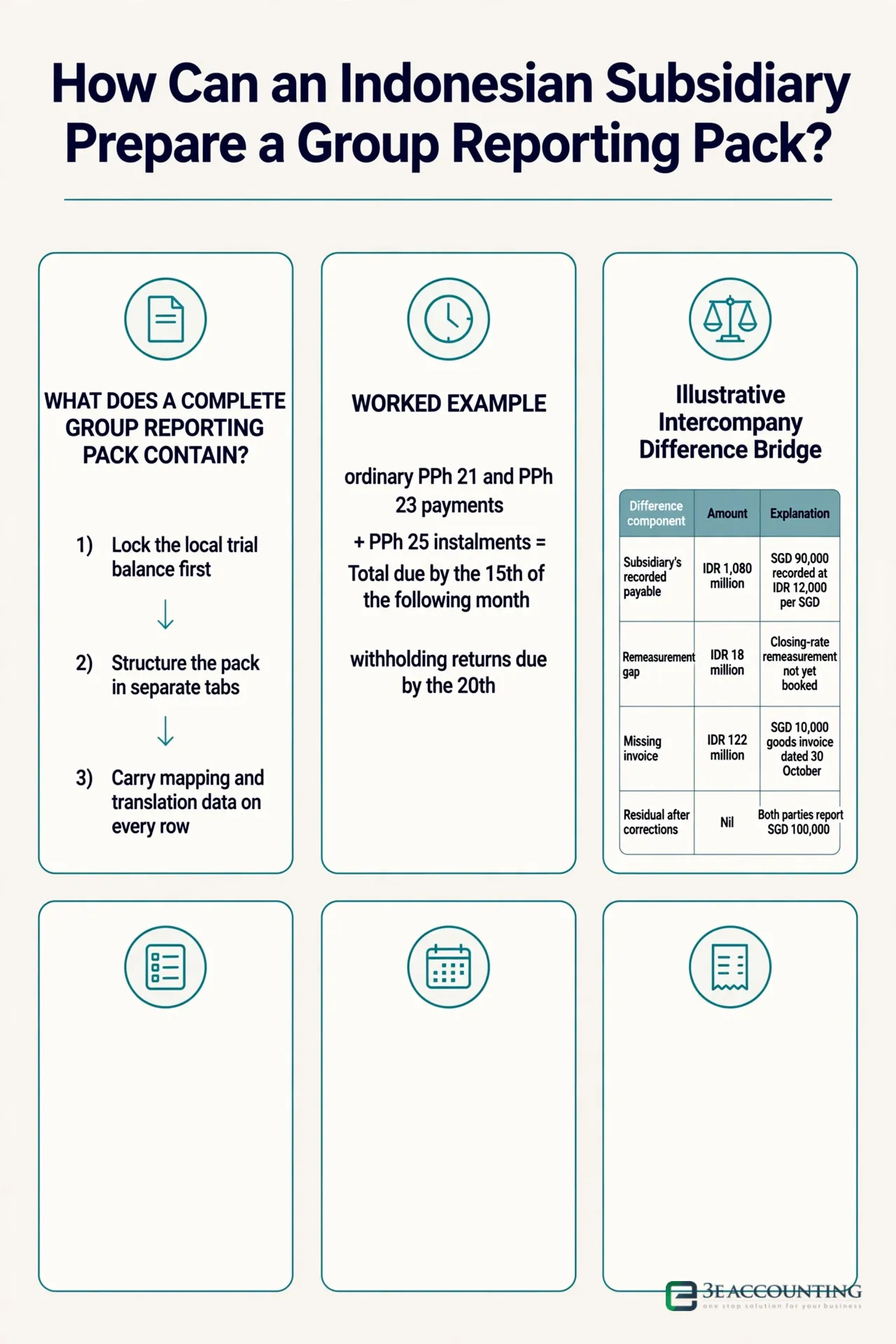
1. Lock the local trial balance first
As a proposed control, freeze a complete export and store it read-only. Reconcile mapped, translated and adjusted outputs to that version. If local corrections follow the lock, bridge them separately or issue a newly locked version and reconcile outputs to it.
2. Structure the pack in separate tabs
A suggested layout separates instructions, rates, the trial balance, mapping, journals and translated statements. It also separates intercompany, tax, roll-forwards and commentary. This is a proposed design, not an observed parent template; adapt it to the parent's instructions.
3. Carry mapping and translation data on every row
Suggested fields include the local code and description, opening balance, movement and closing balance, group code, reporting movement, counterparty, intercompany flag, adjustment reference, adjusted functional-currency balance, rate category and SGD amount. Use a supporting allocation table for split mappings without duplicating the source balance. Review the method against the actual ledger and parent template.
How Is a Trial Balance in Indonesia Mapped to Group Accounts?
Map local captions to group accounts and investigate balances that need splitting or supporting evidence.
Mapping makes a local trial balance usable for group reporting. A proposed approach assigns group accounts and records exceptions with an owner, effective date and supporting schedule. The table illustrates possible classifications, not an approved template. Review each classification against the underlying ledger, accounting policies and group chart.
A PPh 23 control account could contain both tax suffered and tax withheld from others; transaction-level evidence would be needed to split it. Payroll and lease controls may also contain different economic items. For inventory, identify write-downs separately; for fixed assets, distinguish cost, accumulated depreciation and revaluation components. Employee-benefit obligations may need current and non-current classification and separate analysis of service cost, finance cost and remeasurements. Output VAT may map to an indirect-tax liability, subject to the actual balances and policies.
1. Split captions that conceal different economic items
Consider splitting tax suffered from tax withheld using transaction-level evidence. Review payroll and lease controls for separate balance-sheet and profit-or-loss items. These are potential issues, not findings from a reviewed ledger.
2. Treat instalments and credits correctly
Consider mapping PPh 25 instalments to current income-tax prepayments. The DJP's corporate tax calculation takes account of instalments and qualifying withholding credits. Map customer-withheld PPh 23 to credits only where creditable and supported; PPh 21 and PPh 23 withheld by the subsidiary may instead be liabilities. These mappings are suggestions: confirm the transactions, entity circumstances and documentation.
3. Do not offset tax balances automatically
A local ledger may net VAT, current tax or deferred tax balances. Do not automatically carry that net figure into the pack. Check the applicable period's presentation and tax-offsetting rules, including the relevant accounting standard.
Illustrative Local-to-Group Mapping for an Indonesia Trial Balance
| Local caption | Group treatment | Points to watch |
|---|---|---|
| Bank balances | Cash and cash equivalents | Classify restricted deposits separately |
| Third-party receivables | Trade receivables | Separate gross balances from loss allowances |
| Intercompany receivables | Group receivables | Track by counterparty and transaction currency |
| Input VAT | Recoverable indirect tax | Allocate non-recoverable VAT to assets or expenses |
| PPh 25 instalments | Current income-tax prepayments | Not tax expense |
| PPh 23 withheld by customers | Income-tax credits | Creditable only with withholding evidence |
| PPh 21 and PPh 23 withheld | Tax liabilities | Map by tax type |
| Lease balances | Right-of-use assets and lease liabilities | Split current and non-current portions |
| BPJS and payroll accounts | Employee-benefit expense and liabilities | Separate statutory from voluntary components |
| Deferred tax | Deferred-tax assets or liabilities | Identify profit-or-loss versus other-comprehensive-income movements |
| Revaluation reserve | Group equity reserve | Subject to group-policy adjustment |
How Do You Translate Accounts in Indonesia to SGD?
Assess functional currency first, remeasure foreign-currency monetary items, then translate the foreign operation into the group's presentation currency.
Under IAS 21, functional currency reflects the primary economic environment in which the entity operates. It is not determined solely by the ledger currency or the parent's preference. Neither entity's functional currency is established here.
If IDR is the functional currency, remeasure foreign-currency monetary items at the closing rate. Foreign-currency non-monetary items measured at historical cost use transaction-date rates, subject to applicable exceptions. For a foreign operation with a non-hyperinflationary functional currency, translate assets and liabilities at closing rates. Translate income and expenses at transaction-date rates. An average is appropriate only when it reasonably approximates those rates.
Foreign-operation translation differences generally go to other comprehensive income and a translation reserve. Confirm consolidation circumstances, exceptions and any allocation to non-controlling interests. A practical control is to use a parent-approved accounting rate table and separate tax-rate control. Confirm the rate source, quotation and workflow with the parent.
1. Confirm the functional currency
Document the functional-currency assessment and consider changes in the economic environment. The ledger and presentation currencies alone do not settle the assessment.
2. Apply the right rate to each item
Remeasure foreign-currency monetary items at the closing rate at each reporting date. Foreign-currency non-monetary items measured at historical cost use their transaction-date rates, subject to applicable exceptions.
3. Route differences to the right place
Foreign-currency monetary-item differences generally go to profit or loss, subject to exceptions. Foreign-operation translation differences generally go to other comprehensive income and a translation reserve. Check the group's consolidation circumstances.
IAS 21 Translation Rules for an Indonesia Subsidiary
| Item | Rate applied | Where differences go |
|---|---|---|
| Monetary items, such as cash and intercompany balances | Closing rate | Profit or loss, through remeasurement |
| Non-monetary items at historical cost | Transaction-date rate | Not remeasured |
| Assets and liabilities, foreign-operation translation | Closing rate | Other comprehensive income |
| Income and expenses, foreign-operation translation | Transaction-date rates, or an average where it approximates them | Other comprehensive income |
| Accumulated translation differences | Not applicable | Translation reserve within equity |
How Does Intercompany Reconciliation Between Indonesia and Singapore Work?
Match invoices by counterparty, period and original currency before bridging translated differences.
A practical reconciliation starts with invoice number, counterparty, period and original currency. Compare the translated balances only after checking those details. This is a proposed process, not evidence of a completed reconciliation.
In a hypothetical bridge, a difference could include an unrecorded invoice and a foreign-currency remeasurement. For a payable recorded at the original rate, the remeasurement component can be calculated as the foreign-currency balance multiplied by the difference between the closing and original rates. Confirm the invoice, receipt, control transfer and rates before deciding whether corrections are appropriate. Retain the evidence and seek the parties' agreement; this is a suggested method, not a completed reconciliation.
Import taxes and unrealised inventory profit can be tracked separately from the bilateral invoice match. This proposed division does not remove the need to assess tax and consolidation effects. IFRS 10 addresses elimination of intragroup balances and profits on consolidation.
Step 1: Match invoices in their original currency
Compare invoice number, counterparty, period and original-currency amount across both ledgers. Investigate remaining differences rather than assuming they are translation noise.
Step 2: Build a difference bridge
Explain differences such as remeasurement, timing and missing invoices. Keep invoices, receipt evidence and the rate source with the reconciliation.
Step 3: Correct, then obtain both parties' sign-off
Propose corrections where the evidence supports them, then rerun the comparison. Retain the parties' review and approval under the agreed process.
Illustrative Intercompany Difference Bridge
| Difference component | Amount | Explanation |
|---|---|---|
| Parent's receivable in IDR terms | IDR 1,220 million | SGD 100,000 at IDR 12,200 per SGD, an illustrative rate |
| Subsidiary's recorded payable | IDR 1,080 million | SGD 90,000 recorded at IDR 12,000 per SGD |
| Remeasurement gap | IDR 18 million | Closing-rate remeasurement not yet booked |
| Missing invoice | IDR 122 million | SGD 10,000 goods invoice dated 30 October, unrecorded at close |
| Residual after corrections | Nil | Both parties report SGD 100,000 |
Which Group-Only Adjustments Leave the Statutory Books Intact?
A separate group journal can bridge a valid local policy and a different group policy without posting to the local ledger.
A valid local treatment may differ from the group's policy. A separate group-only journal can bridge that difference without posting to the local ledger; this register is a proposed control, not an established engagement workflow. Local errors, however, may require correction in the statutory ledger.
Consider a hypothetical building revaluation that is valid locally when the group uses the cost model. If the revaluation increases the carrying amount without changing the tax base, a group reversal may involve the property balance, the related deferred-tax liability and the revaluation reserve. According to Indonesia's Directorate General of Taxes (DJP), the general corporate income-tax rate is 22%, subject to available facilities and the entity's circumstances. That general rate does not establish the rate for a particular entity or deferred-tax calculation.
The journal is an illustration of a possible method, not a recorded or approved entry. Before preparing it, confirm the tax base, applicable rate, group cost basis, prior revaluation history, how the increase was recognised and any subsequent depreciation. Obtain qualified review and the required authorisations.
1. Document the trigger and the calculation
State why the adjustment exists, the policy difference it addresses, and how each figure was derived. A journal without a stated rationale cannot be reviewed.
2. Keep group journals in a separate register
A proposed register records group-only journals and their adjustment references separately. Confirm authorisation and keep the local ledger unchanged for genuinely group-only entries.
3. Reconcile the register back to the locked trial balance
Reconcile adjusted outputs to the locked source through the journal references. Consider this a traceability control, subject to the actual reporting process.
Illustrative Monthly Close Calendar for the Pack
| Working day | Task | Typical owner |
|---|---|---|
| Day 1 | Close local ledgers and lock the trial balance | Subsidiary finance team |
| Day 2 | Complete account mapping and supporting allocations | Reporting preparer |
| Day 3 | Match intercompany invoices with the Singapore parent | Both finance teams |
| Day 4 | Translate to SGD and prepare group-only journals | Reporting preparer |
| Day 5 | Review, variance commentary and sign-off | Group reviewer |
| Day 6 or 7 | Submit the pack to the parent | Reporting preparer |
What Tax Deadlines and Close Calendar Shape the Pack?
Agree the pack deadline with the parent; tax deadlines follow a separate calendar.
Indonesia's tax calendar gives the month its rhythm. Under guidance published by the Indonesian tax authority, ordinary PPh 21 and PPh 23 payments and PPh 25 instalments are generally due by the 15th of the following month, with the related withholding returns generally due by the 20th. A qualifying PPh 25 payment that is validated counts as submission of the monthly PPh 25 return. For an ordinary monthly VAT return, the general deadline is the end of the following month, with the VAT shortfall paid before filing. Confirm the entity's specific obligations, exceptions and any holiday-adjusted dates, because these are tax deadlines, not the parent's pack deadline.
An early pack does not wait for every return. Where a tax return is not yet filed at pack date, report from reconciled tax accruals and log the differences that later emerge between the return and the ledger. That true-up control keeps the pack timely without deferring compliance.
The pack's own deadline is a working-day target agreed with the parent — some groups ask for day six after close, others day seven, and the answer is a parent decision made before the reporting year starts, not a local guess. The table in the previous section shows an illustrative calendar. When we build a pack for businesses expanding into multiple markets, the first month usually surfaces the items to check: omitted subledger transactions, withholding-related intercompany differences, unmapped balances and inconsistent rates. If any of this feels heavy, contact us and we will scope the handover with you.
1. Assign every task to a named owner
Assign owners and dates for local close, mapping, intercompany matching, review and submission. The roles and timetable should reflect the parent's instructions.
2. Review before you submit
Align pack detail, recognition bridges and review responsibilities with the parent's framework and materiality assessment. Ask the parent to confirm investigation and escalation thresholds.
3. Run the onboarding checks early
Consider reconciling subledgers, confirming rate sources and testing the intercompany match before submission. Escalate unresolved items through the agreed process.
Conclusion
A useful pack starts with a complete local trial balance. It connects mappings, translation, intercompany checks and group-only adjustments back to that source. The parent sets the pack target; tax deadlines follow their own calendar.
Our team can help structure a reporting workflow around the parent's template, framework and materiality assessment. This can include mapping, rate controls and intercompany reconciliation.
Need a Reporting Pack Your Parent Can Trust?
Talk to our team about building an Indonesia-to-Singapore reporting workflow, from account mapping to intercompany sign-off.
Frequently Asked Questions
Not necessarily. Assess functional currency independently of the ledger and the parent's presentation currency. Apply the relevant translation requirements and confirm the parent's rate instructions.
PPh 25 instalments are generally income-tax prepayments. The corporate tax calculation takes account of instalments and qualifying withholding credits. Confirm creditability and supporting documentation.
Possible causes include remeasurement, timing and unrecorded invoices. Match counterparty, period and original currency first, then investigate each difference.
A genuinely group-only adjustment does not post to the local ledger, but local errors may require statutory-ledger correction. A separate register can bridge it to the locked trial balance, subject to the agreed authorisations.
Agree the working-day target with the parent. Neither a suggested close sequence nor Indonesia's tax deadlines establishes the pack deadline.

Abigail Yu
Director
Abigail Yu oversees executive leadership at 3E Accounting Group, leading operations, IT solutions, public relations, and digital marketing to drive business success. She holds an honors degree in Communication and New Media from the National University of Singapore and is highly skilled in crisis management, financial communication, and corporate communications.