

Your Romanian subsidiary keeps statutory books in RON, while its foreign parent may require an IFRS reporting package in another currency. Making one trial balance serve two masters is a monthly discipline, not a year-end rescue.
In this article, we propose a bridge between the Romanian books and the parent’s reporting package. We cover mapping, adjustments, the close calendar, currency translation and reconciliation controls.
What Rules Govern a Romanian Subsidiary's Books?
Romanian statutory books are kept in Romanian and RON, and the applicable framework depends on the entity's legal form, sector and status.
According to Accounting Law No. 82/1991, Article 3 requires accounting in Romanian and in the national currency, the Romanian leu (RON). Foreign-currency transactions are recorded in both RON and the foreign currency concerned. Confirm the current consolidated text and its application to your entity before relying on it.
The regulations differ by entity. OMFP 1802/2014 governs many companies. OMFP 2844/2016 applies an IFRS-based framework to entities within its scope. Check the entity's legal form, sector and status before selecting its framework.
Foreign-currency balances are also remeasured locally. According to the Romanian Ministry of Public Finance, OMFP 1802/2014 point 325 generally requires foreign-currency receivables and payables to be remeasured monthly, using the National Bank of Romania rate for the month's last banking day. Check the rule's scope and exceptions; it should not be generalised to every foreign-currency balance.
Statutory audit obligations are separate. According to the Romanian Ministry of Public Finance, under OMFP 1802, size criteria and consecutive-year conditions can be relevant. Check the rules for the entity's reporting year and sector before determining its status.
Group adjustments belong in a separate overlay. Legitimate local bookkeeping corrections can still be posted to the statutory books. If your group is weighing other Central and Eastern European locations, our guide on why set up business in Hungary examines a neighbouring option with its own reporting quirks.
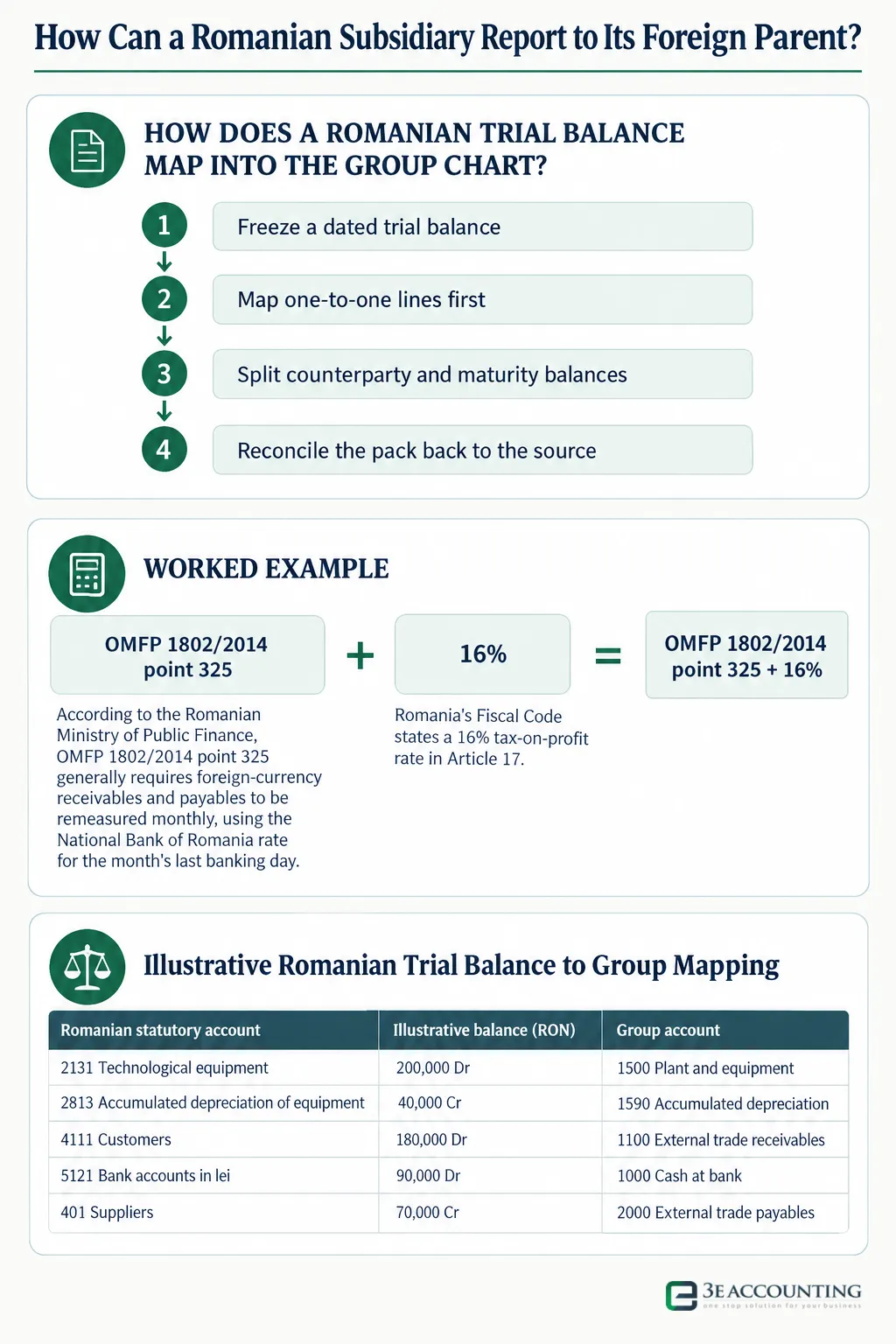
How Does a Romanian Trial Balance Map into the Group Chart?
A mapping can link local lines directly, split them using transaction details or add separately controlled group adjustments.
Our team's proposed bridge starts with a frozen Romanian trial balance. Map it to the parent's chart, add controlled group adjustments, then reconcile the result to the submitted pack. This is an unvetted model, not a confirmed account of the firm's practice.
Mapping depends on the local accounts, transaction detail and parent instructions. Some lines may map one-to-one. Customer, supplier, revenue or expense balances may need counterparty or transaction-level splits. Borrowings may also need a current and non-current split using maturity data. Do not guess splits from closing balances.
Some group balances may arise from conversion adjustments rather than a source line. According to the IFRS Foundation, IFRS 16 right-of-use assets and IAS 12 deferred tax balances may have no direct source line in the statutory trial balance. These are possible examples. This does not mean Romanian accounting has no lease or deferred-tax treatment. Confirm the applicable framework and group policy before deciding on an adjustment.
The mapping table is a hypothetical extract, not a complete trial balance. Its displayed rows do not establish a total or profit. The codes, classifications, intercompany postings and figures remain unconfirmed. Replace them with actual ledger detail and parent instructions, and obtain technical review before using the extract.
1. Freeze a dated trial balance
The proposed control timestamps the statutory trial balance and reconciles it to the local general ledger. The frozen source then anchors the pack.
2. Map one-to-one lines first
Cash, capital, fixed assets and accumulated depreciation usually pass straight across to the group chart. Clearing these first keeps attention on the balances that genuinely need judgement.
3. Split counterparty and maturity balances
Customers, suppliers, revenue and borrowings are split from underlying detail: counterparty for intercompany matching, maturity for current versus non-current presentation. No percentage guessing.
4. Reconcile the pack back to the source
Rebuild the submitted pack from the frozen trial balance and approved overlay. Investigate any variance before submission. Log legitimate local corrections separately and update the bridge when necessary.
Illustrative Romanian Trial Balance to Group Mapping
| Romanian statutory account | Illustrative balance (RON) | Group account | Mapping type |
|---|---|---|---|
| 2131 Technological equipment | 200,000 Dr | 1500 Plant and equipment | One-to-one |
| 2813 Accumulated depreciation of equipment | 40,000 Cr | 1590 Accumulated depreciation | One-to-one |
| 4111 Customers | 180,000 Dr | 1100 External trade receivables | Map separately from intercompany receivables recorded in account 4511. |
| 5121 Bank accounts in lei | 90,000 Dr | 1000 Cash at bank | One-to-one |
| 401 Suppliers | 70,000 Cr | 2000 External trade payables | Map separately from intercompany payables recorded in account 4511. |
| 408 Suppliers – invoices not received | 20,000 Cr | 2020 Accrued supplier costs | One-to-one |
| 1621 Long-term bank loans | 100,000 Cr | 2300 Borrowings, split current and non-current | Split by maturity |
| 704 Services rendered revenue | 210,000 Cr | 4000 External revenue; 4010 Intercompany revenue | Split by counterparty |
| No statutory source | n/a | 1200 Right-of-use asset; 2400 Deferred tax | Conversion-only |
Which Adjustments Belong Only in the Group Overlay?
A group-policy difference may require a separately controlled overlay without changing the statutory books.
A lease can illustrate a possible group-only adjustment. The following is hypothetical, not an engagement record or an approved worked example. Assume rent of RON 1,200 is posted to account 6123 in the Romanian books. Assume the lease is treated as an operating lease locally but recognised on balance sheet in the parent's IFRS pack.
The draft assumes an initial right-of-use asset and lease liability of RON 60,000. It also assumes monthly depreciation of RON 1,000 and interest of RON 300. On those assumptions, the proposed overlay recognises the asset and liability, removes rent expense, accrues interest and records depreciation. It gives a closing asset of RON 59,000 and liability of RON 59,100. Group profit would be RON 100 below statutory profit before deferred tax.
None of those figures or classifications is confirmed. The chart code, contract, commencement date, payment timing, discount rate and calculations need review. The example must be rebuilt or replaced and reviewed before publication or use. It should not be treated as a continuation of any other unreviewed numerical example.
According to the IFRS Foundation, IFRS 16 generally requires a lessee to recognise a right-of-use asset and lease liability, followed by depreciation and interest. Assess recognition exemptions and the actual contract. A group measurement difference does not imply that Romanian accounting has no lease treatment.
Deferred tax needs a separate assessment. Romania's Fiscal Code states a 16% tax-on-profit rate in Article 17. Check current law and the entity's regime before applying it. According to the IFRS Foundation, IAS 12 requires assessing temporary differences and whether deferred-tax assets are recoverable. The initial-recognition exemption does not apply when a transaction initially creates equal taxable and deductible temporary differences. The lease's tax bases, deductibility, recoverability, offset and numerical calculation remain unconfirmed.
A proposed publication control is review by a Romanian accounting reviewer, an IFRS specialist and a tax specialist. No reviewer has been identified or has approved this article.
What Goes into a Romania Subsidiary Monthly Reporting Package?
The pack centres on the trial-balance bridge, the primary statements, intercompany matching, rollforwards and variance commentary, assembled on a disciplined close calendar.
Structure comes first. The proposed calendar measures business days from calendar month-end (D0). Its milestones are unconfirmed, not statutory deadlines or a 3E service commitment. Agree the timetable and owners with the parent. Check statutory deadlines separately against current rules.
What the parent typically requests includes:
- the statutory-to-group trial-balance bridge and mapping
- balance sheet, income statement and cash-flow support
- receivables and payables ageing
- intercompany matching by counterparty and currency
- fixed-asset and lease rollforwards
- accruals, prepayments and inventory support where relevant
- current and deferred tax schedules
- debt maturities, equity movements and actual-versus-budget commentary
Our team's proposed approach prioritises a missing intercompany confirmation over a cosmetic formatting slip. The missing confirmation can affect both the reported balance and the consolidation elimination. Any journal arriving after the freeze enters a late-adjustment log that flags whether it touches the local ledger, the group overlay, or both.
For the wider picture, our overview of overseas operations support from a global accounting network shows how this calendar sits inside a coordinated, multi-country compliance routine.
Sample Romania Subsidiary Monthly Reporting Calendar
| Working day | Activity in the close |
|---|---|
| Before D0 | Cutoff instructions circulated for invoices, payroll, inventory and intercompany postings |
| D+1 | Bank statements, sales and purchase extracts, payroll postings and missing-invoice detail collected |
| D+2 | Bank and control-account reconciliations, accruals, prepayments, fixed-asset movements and local currency remeasurement |
| D+3 | First statutory trial balance frozen; intercompany balances and transactions confirmed |
| D+4 | Mapping completed; group-policy adjustments, lease calculations and tax schedules prepared |
| D+5 | Pack translated, validation checks run, variance commentary written |
| D+6 | Local reviewer approval |
| D+7 | Pack submitted to the parent |
How Are Romanian Accounts Translated into the Group Currency?
Translation is three separate decisions: the statutory bookkeeping currency, the IFRS functional currency and the group presentation currency, each of which needs its own evidence.
The statutory currency is settled by law: the books are kept in RON. The functional currency is not. Under IAS 21, functional currency follows the entity's primary economic environment. Relevant factors include the currencies that mainly influence sales prices and operating costs. Bookkeeping in RON does not by itself establish RON as the functional currency, and the assessment is documented rather than assumed.
For a RON-functional subsidiary reporting to a EUR-presenting parent, local foreign-currency remeasurement is completed first, then any IFRS measurement adjustments, and only then is the RON group-adjusted trial balance translated into EUR. Documenting that sequence helps explain the reconciliation.
The rate table summarises IAS 21 for a non-hyperinflationary functional currency translated into a different presentation currency. Assess exchangeability and any hyperinflationary circumstances for the actual pack. Assets and liabilities translate at the closing rate. Income and expenses translate at transaction-date rates, with a monthly average acceptable only where it reasonably approximates those rates; significant volatility makes a simple average inappropriate. Equity contributions use historical transaction-date rates, and retained earnings roll forward from translated opening balances, translated profit and distributions.
The resulting presentation-currency difference goes to other comprehensive income and accumulates in a separate equity translation reserve. It is never used as a profit-and-loss balancing figure, and it is distinct from the remeasurement of foreign-currency transactions within the local books.
Our team's proposed monthly schedule runs both views side by side: opening RON balance, local movements, group adjustments and closing RON balance, next to opening EUR, translated movements, closing-rate EUR and the translation difference. At year-end, we reconcile the sum of the translated monthly results to the annual translation calculation and explain any true-up. The whole year's profit is never silently retranslated at December's average rate. Where the functional currency is not RON, a separately documented conversion into that functional currency comes first.
IAS 21 Rates for Romanian Accounts Currency Translation
| Item | Rate generally used under IAS 21 |
|---|---|
| Assets and liabilities | Closing rate at the reporting date |
| Income and expenses | Transaction-date rates; a monthly average only where it reasonably approximates them |
| Equity contributions | Historical transaction-date rate |
| Retained earnings | Roll forward from translated opening balances, translated profit and distributions |
| Presentation-currency differences | Other comprehensive income, accumulated in a separate translation reserve |
What Controls Keep the Bridge Auditable?
A frozen source, a separate overlay ledger, counterparty-level matching and a review trail are what allow the bridge to survive audit questions months later.
Evidence is the product. The proposed evidence includes a timestamped trial balance reconciled to the local general ledger. Separately identified conversion journals show which entries belong only to the group overlay. Legitimate local corrections can still be posted and tracked.
Design choices also matter. Audit status, the applicable framework, tax treatment and the parent's own controls can change the bridge's shape, and where reconciliation demands grow, a parallel group reporting ledger can be useful. That ledger supports consolidation; it never replaces the required Romanian records.
If you are still choosing who should run this process across your group, our twelve questions for a multi-country expansion consulting partner provide a structured checklist for that appointment.
1. Run a controlled late-adjustment log
Every journal arriving after the freeze is logged with its value, its source and whether it affects the local ledger, the group overlay, or both. Material items are agreed with the parent before submission.
2. Match intercompany by counterparty and currency
Confirmations are collected before the pack is finalised, because mismatches distort both the balance and the elimination. Unmatched balances are escalated, not netted away.
3. Separate local errors from policy differences
A genuine bookkeeping error, such as an invoice posted twice, belongs in the Romanian books. If discovered after the freeze, log the correction and update the bridge. A valid difference between local and group policy stays in the overlay only, as the error table sets out.
Local Errors versus Group Policy Differences
| Type | Example | Where it is fixed |
|---|---|---|
| Local bookkeeping error | Supplier invoice posted twice to account 401 | In the Romanian statutory books, before or after the trial balance is frozen |
| Valid policy difference | Rent expensed locally against right-of-use accounting under IFRS 16 | In the group overlay only |
| Conversion-only balance | Deferred tax on a temporary difference measured differently at group level | In the group overlay, on an approved calculation |
Conclusion
A Romanian subsidiary's reporting bridge connects statutory records to the parent's package. Mapping, separately controlled adjustments and currency translation each need evidence. Local corrections remain possible and should be tracked.
Our team proposes the workflow in this article as a model for discussion, not as a confirmed account of current practice. The timetable, examples and entity-specific treatments need review and agreement.
3E Accounting Global is a network of independent corporate services providers. Contact our Corporate Professional Advisors to discuss your reporting requirements.
Build a Romanian Bridge That Reconciles Every Month
Tell us about your parent's reporting calendar and we will scope the trial-balance bridge, group-only adjustments and currency translation for your Romanian entity.
Frequently Asked Questions
No. The statutory books stay under the applicable Romanian framework and in RON, while group IFRS adjustments live in a separate overlay. The exception is an entity that itself falls within an IFRS-based Romanian framework, which is confirmed from its legal form, sector and status.
Review the mapping at each close. Some balances may need transaction-level splits, while group adjustments may create balances without a direct source line. The treatment depends on the local accounts and parent instructions.
For a non-hyperinflationary functional currency translated into a different presentation currency, IAS 21 generally uses closing rates for assets and liabilities and transaction-date rates for income and expenses. An average is appropriate only if it reasonably approximates transaction rates. Check exchangeability and hyperinflationary circumstances. Local remeasurement depends on the applicable Romanian regulations.
It goes into a late-adjustment log recording its value and whether it affects the local ledger, the group overlay, or both. Material items are agreed with the parent before the pack is submitted.
No. They are proposed contractual reporting milestones for the pack. Statutory filing and audit obligations follow their own rules, confirmed against the requirements applicable to the entity's reporting year.

Abigail Yu
Director
Abigail Yu oversees executive leadership at 3E Accounting Group, leading operations, IT solutions, public relations, and digital marketing to drive business success. She holds an honors degree in Communication and New Media from the National University of Singapore and is highly skilled in crisis management, financial communication, and corporate communications.